Donor retention decides how much of next year's fundraising you have to rebuild from nothing, since every donor who gives again is one you did not have to go out and find.
Below you will find the current benchmark with its source and year, the formula with a worked example, 10 strategies and a 12-month plan. Most retention guides leave out how donor recognition gifts help keep giving society members and long-standing major donors close, so we cover that too. We make those gifts for more than 300 institutional clients.
Donor retention measures who gives again
Donor retention is the share of last year's donors who gave again this year. It is usually measured year over year and it counts people, so a donor who gave $25 counts the same as one who gave $25,000.
The short version
- The average donor retention rate was 43.3% in 2025, according to the Fundraising Effectiveness Project's full-year 2025 report.
- Donor retention rate equals returning donors divided by last year's donors, times 100.
- The biggest gains sit in the 2nd gift. Donors who give once are far less likely to return than donors who give often.
- Loyal and major donors are kept through stewardship, which means personal contact from someone they know and recognition when they reach a milestone.
The related terms
- Donor attrition is the reverse of retention: the share of last year's donors who did not give again.
- A lapsed donor gave in an earlier period but has not given in the current period.
- A recaptured donor is a lapsed donor who gives again.
- Donor lifetime value estimates what a donor gives over the whole relationship.
Why retention matters
Keeping a donor who already gives costs nothing in list purchases or advertising. Retention also feeds the larger gifts. A donor who has given for 10 years already trusts you, and conversations about a named scholarship or a bequest usually start from that kind of trust.
The average donor retention rate is 43.3%
The benchmark in this guide comes from the Fundraising Effectiveness Project, which tracks giving data across thousands of nonprofit organizations. In its full-year 2025 report, overall donor retention was 43.3%, up from 43.1% the year before.
That report covers 15,102 nonprofit organizations, 7.8 million donors and $13.2 billion in gifts. Over the year the number of donors fell by an estimated 3.6% while dollars rose by an estimated 5.0%, so more of the money is coming from a smaller group of people, and each one you keep carries a larger share of it.
| Measure | Rate | Period | Report |
|---|---|---|---|
| Overall donor retention | 43.3% | Full year 2025 | 4th quarter 2025 |
| Donors who gave 7 or more times the year before | About 90% | 2026 to June, year to date | 2nd quarter 2026 |
| Single-gift donors | 14.4% | 2026 to June, year to date | 2nd quarter 2026 |
| Donors acquired in 2025 who have given again | 11.3% | 2026 to June, year to date | 2nd quarter 2026 |
| Overall donor retention, year to date | 26.4% | 2026 to June, year to date | 2nd quarter 2026 |
Sources: the Fundraising Effectiveness Project's 4th quarter 2025 report and its 2nd quarter 2026 report, the latest at the time of writing.
New donors are the hardest to keep
The full-year 2025 report describes new donor retention as essentially flat, while repeat donor retention improved. This year's figures show how steep the drop is after a 1st gift. By the end of June 2026, only 11.3% of donors acquired in 2025 had given again, according to the 2nd quarter 2026 report.
Repeat donors are far more loyal
In the same 2026 report, the number of retained repeat donors grew 3.1% while retained new donors fell 9.5%. Once someone has given to you a few times, they tend to keep going.
Donors who give often stay longest
Donors who gave 7 or more times in the prior year were retained at about 90%, against 14.4% for single-gift donors. You can build that kind of frequency. Monthly giving does a lot of it, and regular updates give donors a reason to give more than once a year.
Quarterly and full-year rates measure different things
The Fundraising Effectiveness Project's quarterly reports are year to date, so the 26.4% overall retention for January to June 2026 counts only donors who had given again within 6 months. It does not mean retention fell from 43.3%. The project also moved to a new methodology from its 1st quarter 2026 report, so read its notes before you treat 2025 and 2026 as a trend.
A good donor retention rate beats your own last year
A good donor retention rate depends on who your donors are. Start with the sector: an overall rate above 43.3% means you kept more donors in 2025 than the average organization in the Fundraising Effectiveness Project's dataset. An organization whose donors are mostly event guests or people answering an emergency appeal will usually sit lower, and an alumni fund with a solid base of donors who give every year should sit higher.
Your own history is the better guide, so track a 3-year trend for each segment. If first-time donor retention rose from 18% to 24% over those 3 years, your welcome program is working, wherever that leaves you against the sector average.
Set a target for each segment
Different donors return at very different rates, so set separate targets for:
- First-time donors
- Repeat donors
- Monthly donors
- Major donors, above a gift threshold you set
- Giving society members
Set each target a few points above this year's rate, and name the person who owns it.
The donor retention rate formula is simple
Divide returning donors by last year's donors
Donor retention rate equals the number of donors who gave last year and gave again this year, divided by the number of donors who gave last year, times 100.
Worked example. In 2025, 1,200 donors gave. Of them, 516 gave again in 2026. Divide 516 by 1,200 and you get 0.43, so the donor retention rate is 43%.
There are 2 errors we see often. One is counting new donors in the top line, when someone who first gave in 2026 did not give in 2025 and so cannot have been retained. The other is dividing this year's repeat donors by this year's total donors. That tells you about the mix of your donor file, but nothing about how many donors you kept.
First-time and repeat retention need separate counts
Run the same formula on each group. Suppose 400 of the 1,200 donors in 2025 were giving for the 1st time and 800 had given before. If 80 of the first-time donors and 436 of the repeat donors gave again in 2026, first-time retention is 20% and repeat retention is 54.5%. The overall figure of 43% hides a gap of more than 30 points between the 2 groups.
Do the same for major donors and for each giving society.
Your donor database can produce the numbers
- Fix the reporting period. Use the same 12 months each year, calendar or fiscal.
- Count unique donors. Merge duplicate records and settle how households and joint gifts count.
- Leave out revenue that is not a donation. Event tickets, auction purchases and shop sales are transactions.
- Tag every donor by lifecycle stage. First-time, repeat, lapsed and recaptured.
Save the query so it runs the same way next year.
Attrition and lifetime value complete the picture
Donor attrition rate is 100 minus the retention rate. In the example, 100 minus 43 gives 57% attrition: 684 of the 1,200 donors did not give again.
Donor lifetime value is the average gift, times the number of gifts a year, times the number of years a donor stays. A donor who gives $150 twice a year for 6 years is worth $1,800. Keep that donor for 8 years and the figure rises to $2,400.
Donors stop giving for reasons you can fix
The common reasons
Blackbaud's donor retention glossary lists the usual reasons donors leave: they did not feel appreciated, they heard from you too often or too rarely, they could not see where their money went, a question went unanswered, giving was awkward, or another cause won their attention. Then there are changes in the donor's own life, like a move or a retirement, that no plan will prevent.
Most of the reasons you can do something about come down to thanks and evidence. When a donor is thanked quickly and later shown what the gift paid for, there are fewer reasons left for them to drift.
The warning signs come early
- Gifts get smaller or less frequent.
- Thank-you emails and calls go unanswered.
- The donor stops coming to events or volunteering.
- A complaint, however small, sits unresolved.
Review these signs every month. A donor who skipped the spring appeal is easier to keep in May than in December.
These 10 strategies keep donors giving
The strategies run in order of donor stage, from the 1st gift to the 10th year. If you can only focus on 1 area, make it the 2nd gift, because the gap between donors who give once and donors who give often is the widest in the data.
1. Thank every gift quickly and personally
Send a thank-you within 48 hours, signed by a named person the donor can reply to. For a 1st gift above a threshold you choose, add a call from a board member, made only to say thank you. Our guide to thank you letters for donations has templates for each kind of donor.
2. A welcome series turns 1st gifts into 2nd gifts
Plan 3 or 4 messages over the 90 days after a 1st gift. The first thanks the donor and tells a short story, and the later ones can take them behind the scenes or invite them to a tour or a call. Make no ask in the opening message. The 2nd ask should come after the donor has heard what the 1st gift did.
3. Report what each gift achieved
Donors give again when they can see the result. Send a short impact update every quarter and, for endowed and major donors, a personal fund report each year. Our guide to stewardship and donor impact reports includes examples and a template.
4. Monthly giving keeps donors by default
A monthly gift renews itself until the donor stops it, so staying becomes the default. Offer it on the donation form and in the welcome series, and thank monthly donors on the anniversary of their 1st gift.
5. Personal outreach follows giving history
A donor whose giving rose 2 years running, or who has given for 5 years without a break, deserves a call from a gift officer or a note from the head of the program they support.
6. Invitations beyond the ask build attachment
Invite donors to see the work for themselves at a lab tour, a rehearsal, a lecture or a ward opening, and leave the ask out of it. Our list of donor appreciation event ideas covers formats for every budget.
7. Giving societies give loyalty a name
A society for donors who give every year, or for a set number of consecutive years, turns a habit into a membership. Give it a name and a proper welcome, and send members something they can wear or display, such as a lapel pin or a desk piece. Our page on stewardship gifts for giving societies and major donors shows how institutions mark membership.

8. Milestone gifts mark years of support
The 5th and 10th consecutive years of giving are worth marking with a personal note and, for leadership donors, a gift. The next section covers when a gift fits and what it can be.
9. Donor surveys show what to fix
Once a year, ask donors why they give and how they like to hear from you. It is also worth asking what would make them give again. Act on the patterns you see, and tell donors what you changed because of their answers.
10. Lapsing donors hear from you before they lapse
If a donor has not renewed 10 months after their last gift, get in touch without an ask, with an update on the work they funded or an invitation. Keeping someone at that point takes far less effort than winning them back after the year has run out.
Recognition gifts keep loyal and major donors close
Most retention advice stops at email and events. For loyal and major donors, stewardship also includes recognition they can hold, such as an object that marks their place in a giving society or the close of a campaign they helped finish. A gift will not keep a donor by itself, but it marks a moment the donor earned and stays on a desk or a lapel long after the letter is filed.
The moments that call for a gift
- Induction into a giving society, with the insignia arriving alongside the welcome letter.
- The 5th or 10th consecutive year of giving.
- The close of a campaign, for the donors who carried it to its goal.
- The anniversary of an endowed fund, sent with the fund's annual report.
- A completed pledge.
Keep the gift well away from any ask, and send it after a commitment as a thank-you.
Gifts we have made for 4 institutions
Emory Goizueta Business School
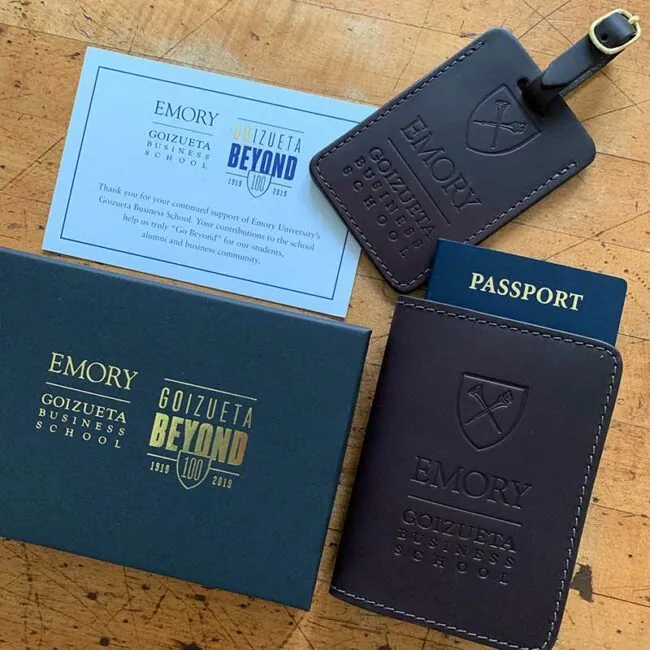
We made brass coasters for the 100 honorees of the School's centennial, along with leather goods for its top donors and a silk scarf and tie drawn from the Goizueta building.
MIT Sloan
We made an embossed leather passport holder and luggage tag for MIT Sloan's top donors, and a pure new wool throw woven with the School's name.

University of Notre Dame
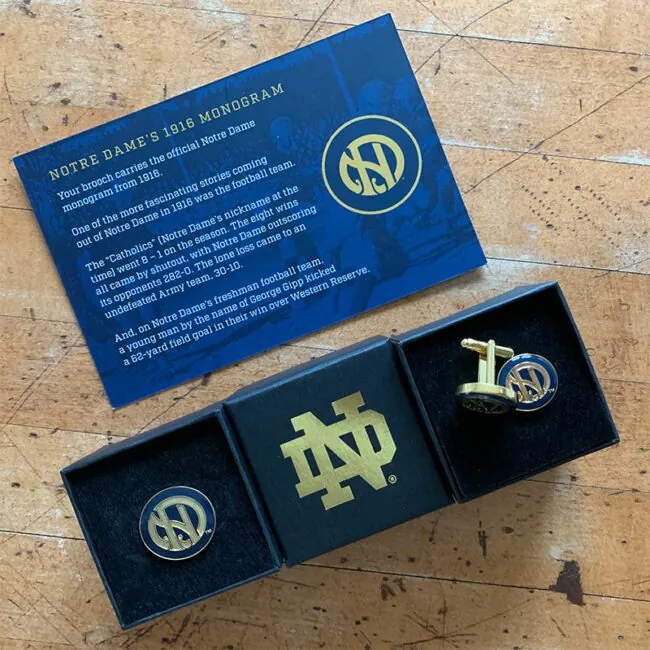
For the University of Notre Dame we designed bespoke enamel cufflinks and a matching brooch, handcrafted in Britain as donor and alumni recognition gifts.
"We cannot thank you enough for the extraordinary heirloom-quality gifts that reflect our deep appreciation for our Benefactors. With your help, we have created unforgettable memories that they will carry with them and share within the Notre Dame community. Collaborating with you has been a true delight!" Jessica Reasons, The University of Notre Dame
Cornell University
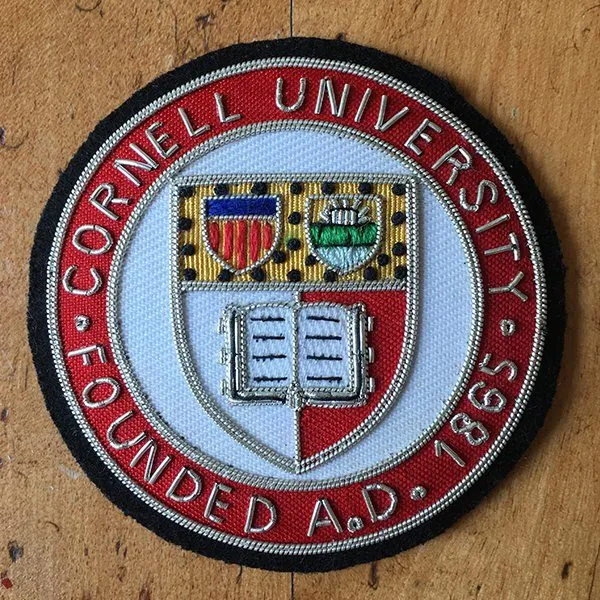
After its $6.36 billion campaign, we curated a made-to-order Alumni Collection for Cornell University, alongside a Saxony wool scarf and a medallion badge.
What makes a recognition gift worth keeping
Every gift above was drawn from scratch for a single institution, from its crest and colors or from a detail of its buildings, as with the Goizueta scarf and tie at Emory. None of them is sold to anyone else. They arrive hand-wrapped in a foil-embossed presentation box branded for the institution, with the thank-you message printed on a notecard and the gift's provenance on the reverse.
Emma Harris starts every design as a hand-drawn sketch and chooses the materials herself. She also inspects every finished piece, and samples are made for your approval before anything goes into production. Our process page explains each step, and our craftsmanship page covers the British mills and foundry, holders of Royal Warrants, that make the gifts.

"Harris Made designs are made with such precision, sophistication, and embody a rich story of tradition. They are the perfect recognition gifts for our most loyal alumni and friends." Emily Abrahamson, Donor Engagement, University of Chicago
Gifts for every giving level
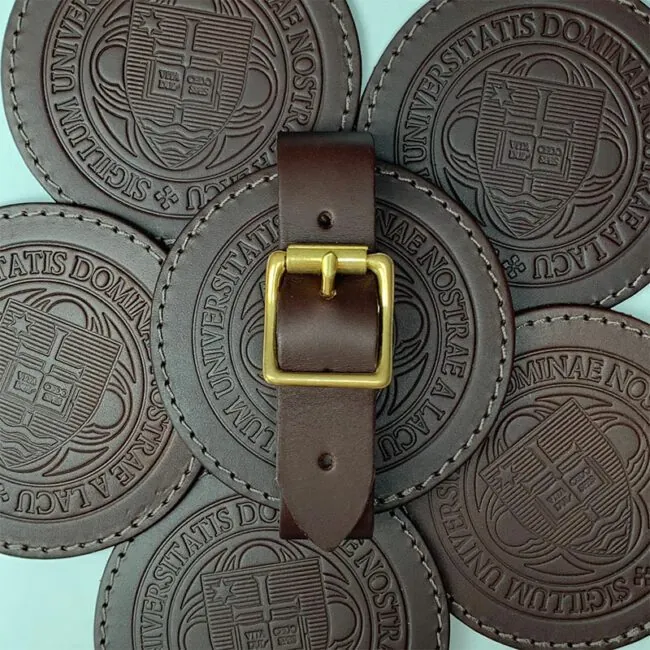
Recognition gifts can follow the tiers of a giving program. Prices start from $15 for a lapel pin, a natural insignia for a giving society. Embossed leather coasters start from $35, brass and nickel coasters from $40 and a brass paperweight from $58. The requested minimum is 125 pieces per design and most projects take 8 to 16 weeks, so plan milestone gifts a season ahead and ask us about timing for a specific date. For more ideas by occasion, see our donor recognition gift ideas.
A 12-month plan puts retention on the calendar
The plan below fits an annual giving program of any size. Shift the months to match your fiscal year, and put a name beside every row.
| When | What happens | For whom |
|---|---|---|
| Month 1 | Calculate overall, first-time and repeat retention for the last 3 years, and set a target for each segment | All donors |
| Within 48 hours of every gift | A thank-you from a named person | All donors |
| Months 1 to 3 after a 1st gift | A welcome series with an impact story and an invitation, with no ask in the opening message | First-time donors |
| Every quarter | An impact update tied to what donors funded | All donors |
| Anniversary of the 1st gift | A personal note | Repeat and monthly donors |
| Month 10 without a renewal | Outreach with no ask: an update, an invitation or a call | Donors at risk of lapsing |
| Once a year | A recognition moment, with a gift in milestone years | Giving society members and major donors |
| Month 12 | Recalculate retention and compare each segment with last year | All donors |
Our donor stewardship guide shows how to build the wider calendar this plan sits inside. For the milestone rows, our page on donor recognition gifts shows what institutions give at each level, and you can start a project whenever you are ready.
Frequently asked questions
What does donor retention mean?
Donor retention is the share of donors from 1 period who give again in the next, usually measured year over year. If 100 people gave last year and 45 of them gave again this year, your donor retention rate is 45%.
What is the average donor retention rate?
The average donor retention rate was 43.3% in 2025, up from 43.1% the year before, across 15,102 organizations in the Fundraising Effectiveness Project's full-year 2025 report.
What is a good donor retention rate?
Above the sector's 43.3% overall is a good start. Compare first-time, repeat and major donors separately, and judge each against your own 3-year trend.
How do you calculate donor retention rate?
Divide the number of donors who gave last year and gave again this year by the number of donors who gave last year, then multiply by 100. If 516 of 1,200 donors from 2025 gave again in 2026, the rate is 43%.
How can a nonprofit increase donor retention?
Thank every gift quickly and personally, use a welcome series to win the 2nd gift, report on impact, offer monthly giving and recognize loyal donors at milestones. The 10 strategies above cover each in turn.
What is the difference between donor retention and donor attrition?
Retention is the share of last year's donors who gave again. Attrition is the share who did not, so it equals 100 minus the retention rate.