
Donor stewardship is the work an advancement team does after a gift arrives: thanking the donor, using the gift as promised, reporting back on what it made possible, and recognizing the donor in a way that fits. Done well, it turns a single gift into a lasting relationship. Our own part in donor stewardship is the recognition gift, a small piece of a larger plan. This guide sets out that larger plan, as we understand it from working with advancement and stewardship officers, and shows where a gift belongs in it.
What donor stewardship covers
Fundraising is often described as a cycle. You identify a prospective donor, cultivate the relationship, ask for a gift, then steward it. Stewardship closes the loop and opens the next one, because a donor who feels well treated is ready to hear from you again.
It helps to think of stewardship as 4 kinds of work:
- Acknowledgment. A prompt, personal thank-you for every gift, from the right person.
- Accountability. Using the gift as the donor intended, and being able to show it.
- Reporting. Telling the donor what their gift made possible, in specifics: the student, the program, the research, the building.
- Recognition and relationship. Bringing the donor closer through events, access, giving societies and, at the right moments, a gift of thanks.
Build a stewardship calendar
Good intentions fade without a calendar. A stewardship calendar lists every planned contact with your donors across the year, by giving level, so nobody is forgotten and nobody hears from 3 offices in the same week. We suggest building it in 2 layers.
Moments triggered by a gift
These happen whenever a gift arrives, whatever the date:
- A thank-you letter, sent within days and signed by someone the donor knows.
- A call or a handwritten note for gifts above a threshold you set.
- A first report on how the gift is being used, as soon as there is something to say.
- The anniversary of the gift, marked with an update or a note.
Fixed points in the year
These recur every year and can be planned well in advance:
- The end of the fiscal year, with thanks to everyone who gave during it.
- Your annual impact or endowment report.
- Giving society events and inductions.
- Scholarship lunches, named fund reports and other moments where donors meet the people they support.
- Board meetings, reunions and campaign milestones.
Lay the 2 layers over each other month by month, with a column for each giving level and a name beside every task. That last part matters most. A stewardship plan without an owner for each step is a wish list.
Match the effort to the gift
Every donor deserves thanks, and the plan behind that thanks should be tiered. A first-time annual donor might receive a prompt letter, a year-end report and an invitation to an event. A leadership donor might receive personal visits, a named report, a seat at a dinner with the president and a bespoke recognition gift. Writing the tiers down, in what many offices call a stewardship matrix, keeps the treatment consistent across officers and across years.
Giving societies
Giving societies give donors a name for their commitment and a group to belong to. A society might recognize annual giving at a set level, consecutive years of giving, or a planned gift. Columbia University's 1754 Society is an example, and we made a paperweight carrying its name in gold and silver gilt wire.
A society works best when membership is visible. An insignia that members can wear or display, such as a lapel pin, a silk scarf or tie, or a desk piece, turns a name in the honor roll into something people see at events and ask about. Keep a single design language across the levels, so a member who moves up can feel the progression.

Where recognition gifts fit
A recognition gift is a single stewardship touch among many. It cannot stand in for a thank-you letter or an impact report, and it works best when it arrives at a moment that already means something:
- Joining a giving society. The insignia arrives with the welcome.
- A campaign launch. Lurie Children's Hospital sent a pashmina and silk tie with the invitation to the kickoff of its For Every Child campaign, asking donors to wear them to the event.
- A milestone year. To mark the 100th year of Emory's Goizueta Business School, we made brass coasters that were given to its 100 centennial honorees.
- A retirement. Purdue's College of Engineering presented a silk scarf and tie, made in secret, at its dean's retirement dinner.
- A completed pledge or a named gift. A desk piece or a leather gift marks the end of a commitment with something permanent.
The note matters as much as the object. We print your thank-you message on a thick, high-quality notecard so recipients can share it during a capital campaign, and the reverse describes the provenance of the gift. That card is a stewardship document in its own right. It tells the donor, in your words, what their support means.
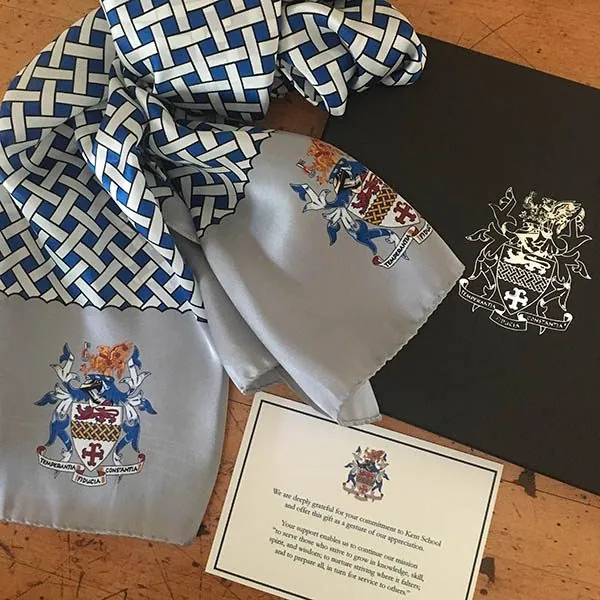
"We were fortunate indeed to find Harris Made when looking for special gifts for our alumni and parents. Harris Made delivered items of exceptional quality with lasting appeal and with a special significance, items that are uniquely KENT. Harris Made provided attention to every detail. Their designs exceeded our expectations, as did their personal touch. Their devotion to their craft is exemplary. We highly recommend Harris Made." Kathy Nadire, Director of Development, Kent School
Put gifts into the calendar early. A bespoke project takes 8 to 16 weeks or more from first sketch to delivery, and our minimum is usually 125 pieces per design, so it often makes sense to design for a year or more of society inductions at once. Our gifts start from $15, which leaves room to recognize several levels with pieces drawn from a single design language.
Measuring donor stewardship
Stewardship can be measured, though the numbers move slowly. Useful measures include:
- Donor retention. The share of last year's donors who gave again this year, tracked by giving level.
- Upgrades. How many donors increased their gift, and by how much.
- Consecutive years of giving. How many donors have given 3, 5 or 10 years in a row.
- Pledge fulfillment. Whether multi-year pledges are paid on schedule.
- Plan completion. Whether every touch on the stewardship calendar happened, on time and from the right person.
- Response. Replies, event attendance and the notes donors send back. When a donor writes to say they wore the scarf to a reunion, record it.
Review the measures each year by giving level and by stewardship officer, then adjust the calendar. The aim is simple: more donors who give again, give more, and feel part of the institution.
If a recognition gift belongs in your stewardship plan, read about our process, or start a project and tell Emma, our designer and co-founder, about your donors and your calendar.
Frequently asked questions
What is donor stewardship?
Donor stewardship is everything an organization does after a gift to thank the donor, use the gift as intended, report on what it made possible and deepen the relationship, so the donor feels valued and is ready to give again.
What is the difference between donor cultivation and donor stewardship?
Cultivation builds a relationship before a gift is asked for. Stewardship cares for the relationship after the gift is made. The 2 overlap in practice, because good stewardship of a gift is the best preparation for the next.
What should a donor stewardship plan include?
A stewardship plan should include a calendar of planned contacts across the year, tiers that match the effort to the gift, a named owner for every task, and the measures you will use to judge it, such as donor retention and upgrades.
When should we give a donor a recognition gift?
At a moment that already means something to the donor, such as joining a giving society, a campaign launch, a milestone anniversary, a retirement or a completed pledge. Plan ahead, because bespoke gifts take 8 to 16 weeks or more from first sketch to delivery.