Alumni engagement is the work of keeping graduates close after they leave campus. Most alumni relations teams already have more ideas than they could run in a year, so a good part of this guide is about choosing among them and then showing the board what changed. The examples come from universities we make university and alumni gifts for.
Alumni engagement is measured in 4 ways
Alumni engagement is the ongoing relationship between graduates and their institution: the messages they read and answer, the events they attend, the time they give as volunteers and the gifts they make. Measuring it means counting each of those activities, which is how a team finds out where alumni have gone quiet.
The Council for Advancement and Support of Education (CASE) runs the best-known framework. Its survey, CASE Insights on Alumni Engagement, began as the Alumni Engagement Metrics survey and counts engagement in 4 modes. Participating institutions use it to compare their results with their peers.
| Mode | What it covers | Ideas in this guide |
|---|---|---|
| Philanthropic | Gifts from alumni | Giving days, reunion class gifts, young alumni giving societies |
| Volunteer | Time given in a defined role | Mentoring, class agents, admissions interviews |
| Experiential | Events and programs alumni attend | Reunions, regional receptions, career panels |
| Communication | Contact that alumni respond to | Segmented newsletters, surveys, alumni stories |
The modes feed each other. A graduate who came to a regional reception in September is easier to ask to mentor a student in January, and a mentor is an easier person to ask for a gift. A good plan has at least 1 idea in each mode, so every group of alumni has more than 1 way in.
The short version
- Plan by mode: philanthropic, volunteer, experiential and communication.
- Segment your alumni first, then choose the ideas that suit each group.
- Put every idea on a 12-month calendar with a named owner.
- Count the alumni engaged in each mode and in at least 1 mode.
- Give volunteers and loyal alumni something to keep, made for your institution alone.
A written plan turns ideas into a strategy
An alumni engagement strategy decides which alumni you most want to reach, and in which modes. The plan is the year of work that carries those decisions out. Keep it to 1 page, since a longer plan tends to stay in a drawer. Here is a template to copy.
| Section | What to write | Example |
|---|---|---|
| Goals | 1 measurable aim for each mode | More volunteers from the classes of the last 10 years |
| Segments | The groups this plan serves | Recent graduates, reunion classes, alumni in Chicago |
| Ideas | 1 to 3 for each mode, chosen for the segments | Career panel, class agent program, giving day |
| Channels | How each segment hears from you | Email, the alumni magazine, class social media groups |
| Calendar | Month by month, as below | Giving day in March, reunion in June |
| Budget | Cost of each idea, including recognition | Venues, travel, volunteer pins, postage |
| Owner | 1 named person for each idea | Assistant director of young alumni programs |
| Measures | What you will count, and when you report it | Alumni engaged by mode, reported each quarter |
Segments decide which ideas to use
An idea that fills a room with recent graduates may mean very little to a 50th reunion class. Start with these segments and add your own.
- Students about to graduate. Introduce the alumni association before they leave, at a senior class toast or a graduation week breakfast.
- Recent graduates. Career help and meetups in the cities they move to, with a first gift small enough to say yes to.
- Reunion classes. A class committee to plan the weekend and a class gift to work toward.
- Parents. Family weekends and updates from the dean. Some will host an event in their own city if you ask.
- Regional groups. Receptions and lectures where alumni live.
- Donors. Stewardship that includes impact reports and invitations to see the work they fund.
- Volunteers. A clearly defined role with some training, and recognition when the term ends.
A 12-month calendar keeps the plan on track
Most alumni offices run on the academic year, so this calendar starts in July. Shift it to match your own fiscal year.
| Month | Main focus | Mode |
|---|---|---|
| July | Set goals and recruit class agents for the coming reunion classes | Volunteer |
| August | Welcome new graduates to the alumni association | Communication |
| September | Regional receptions as the academic year begins | Experiential |
| October | Homecoming and alumni awards | Experiential |
| November | Alumni survey and thank-you notes to volunteers | Communication |
| December | Year-end appeal and class agent letters | Philanthropic |
| January | Launch spring mentoring pairs | Volunteer |
| February | Career panels and virtual lectures | Experiential |
| March | Giving day | Philanthropic |
| April | Volunteer recognition and the senior class toast | Volunteer |
| May | Commencement and the final push on reunion class gifts | Philanthropic |
| June | Reunion weekend, then a review of the year's numbers | Experiential |
Experiential ideas bring alumni back together
Experiential engagement covers the events and programs alumni attend, including those held online. For each of the alumni event ideas below, we note who it suits and how much work it takes, and add 1 tip.
Reunions and homecoming anchor the year
Reunion weekend
Reunions suit milestone classes, usually the 5th, 10th, 25th and 50th. They take a lot of work, much of it carried by a class committee, so thank committee members in person during the weekend. Our guide to reunion and commencement gifts covers what to give them.
Homecoming
Homecoming draws alumni within driving distance and young families, and the work is shared with athletics and student affairs. Hold an alumni gathering before the main event so graduates have a place to find each other.
Family days and behind-the-scenes tours
Parents come, and so do donors who want to see a new building or lab. The effort is moderate. Let a student lead the tour, because alumni ask students what they would never ask staff.
Regional and virtual events reach alumni who cannot travel
Regional receptions
These work in any city with enough alumni to fill a room, and they take a moderate amount of work. Ask an alumnus to host in their home or office. The invitation then comes from someone the guests know.
Faculty lectures and webinars
Lectures suit alumni who miss the classroom more than the parties. They are easy to run, and the recording should go to everyone who registered.
Virtual book clubs
A book club reaches alumni abroad and those short of time, for very little effort. Choose books by faculty or alumni and invite the author to the last session.
Alumni travel
Travel programs suit retired alumni and loyal donors. They are a lot of work, which is usually shared with a travel partner, and it helps to send a faculty member who knows the destination.
Career events draw recent graduates
Career panels and fireside chats
Panels are aimed at graduates in their first 10 years and take low to moderate effort. Seat recent graduates beside senior alumni on the panel, so the room sees a path it could follow.
Service days
A service day suits young alumni and regional groups and takes moderate effort. Choose a cause tied to your mission, and get a photograph of the group for the alumni magazine.
Volunteer ideas give alumni a role to play
Volunteering asks more of alumni than any other mode, because they have to prepare and then show up when they said they would. It also builds the strongest ties. Write each role down with a title and a term, and tell volunteers who to call when they have questions.
Mentoring links alumni to students
- Student mentoring. Pair alumni with students in their field for a term, with 3 or 4 set conversations.
- Admissions interviewers. Alumni meet applicants in their own cities.
- Guest speakers and student panels. Alumni talk to a class or a student club about their work.
Class agents and chapter leaders keep classes connected
- Class agents. 1 or 2 alumni for each class who write to classmates, share news and lead the class gift.
- Regional chapter leaders. Alumni who host events and welcome new graduates to their city.
- Advisory boards. Senior alumni who advise a dean or department on programs and careers.
Recognition keeps volunteers coming back
Volunteers rarely ask to be thanked, so they are easy to overlook. A handwritten note from the dean is a good start. Something to wear marks the role in public, such as a lapel pin from $15 for every class agent and mentor, or a woven club tie from $55 for chapter leaders and board members, with your stripe and emblem carried through the weave.
"Thank you Harris Made for providing remarkable quality silk scarves and ties that were gifted with pride; recognition gifts that are still being talked about with excitement and enthusiasm!" Hadley Thomas, Director of Alumni Relations, College of Engineering, Purdue Research Foundation
Communication ideas keep alumni close between events
Communication reaches more alumni than any event can, and the messages that count most are the ones alumni answer. These ideas invite a reply:
- Segmented newsletters. Separate editions by segment, such as recent graduates or a region, each with 1 clear request.
- Alumni stories. Short profiles that alumni nominate each other for.
- The alumni magazine. Class notes, and a letters page that prints replies.
- Social media takeovers. An alumnus runs the account for a day from their workplace.
- Surveys. Ask alumni what they want from you, then report back on what you changed.
- Personal notes from deans. A few lines, signed by hand, to volunteers and loyal donors.
A good message to alumni is short and personal
The best message thanks the reader for something specific and asks for 1 small action, naming their class or program along the way. Here are 3 to adapt.
A thank-you
Dear [Name],
Thank you for meeting with our engineering students this spring. They told me your advice changed where they applied. Would you mentor 1 more student next term?
With gratitude,
[Dean's name]
A class update
Dear members of the Class of [year],
Your reunion is [number] months away, and [number] classmates are coming. Reply with 1 classmate you would most like to see, and we will invite them personally.
[Class agent's name], for your reunion committee
An invitation
Dear [Name],
Professor [Name] is speaking about [topic] in [city] on [date]. Will you join us, and bring a classmate?
Warm regards,
[Your name], Alumni Relations
Philanthropic ideas turn engagement into giving
Philanthropic engagement is the mode most alumni offices are judged on, and it grows out of the other 3. These ideas work for an office of any size.
- Giving days. 24 hours with a clear goal, and challenges between classes to keep it moving.
- Reunion class gifts. Each reunion class sets a goal, and its class agents lead the effort.
- Young alumni giving societies. A society with a modest entry level that rises with each year since graduation.
- Matching gifts. Remind alumni to ask their employers to match, and thank the employers too.
- Impact reports. Show alumni what their gifts paid for. Our guide to donor impact reports includes a template.
Give young alumni a low-cost way to start, since the habit matters more than the amount in the early years. For thanking alumni donors well after the gift, see our donor stewardship guide.
An alumni collection gives graduates something to keep
Most alumni engagement happens on screens and at events. A scarf in the institution's colors, or a bag from an alumni collection, goes home with the graduate and gets worn and carried for years afterward.
The piece should belong to your institution alone. Every Harris Made design is drawn from scratch around an institution's colors and crest and the story it wants to tell, and it is never sold to anyone else.
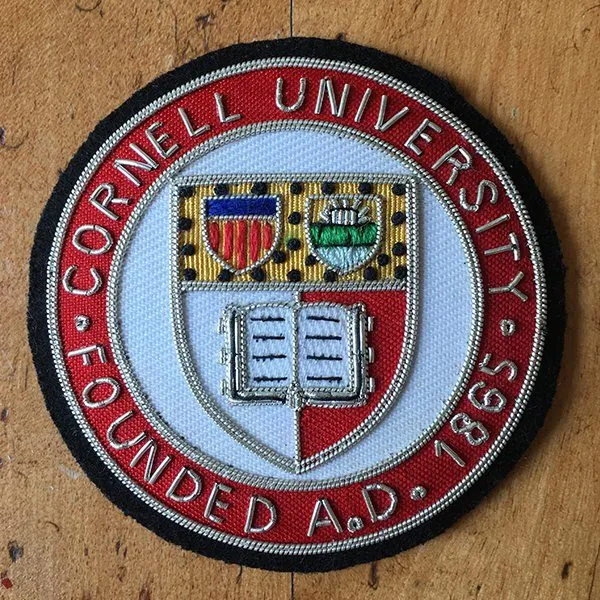
Cornell built a made-to-order Alumni Collection
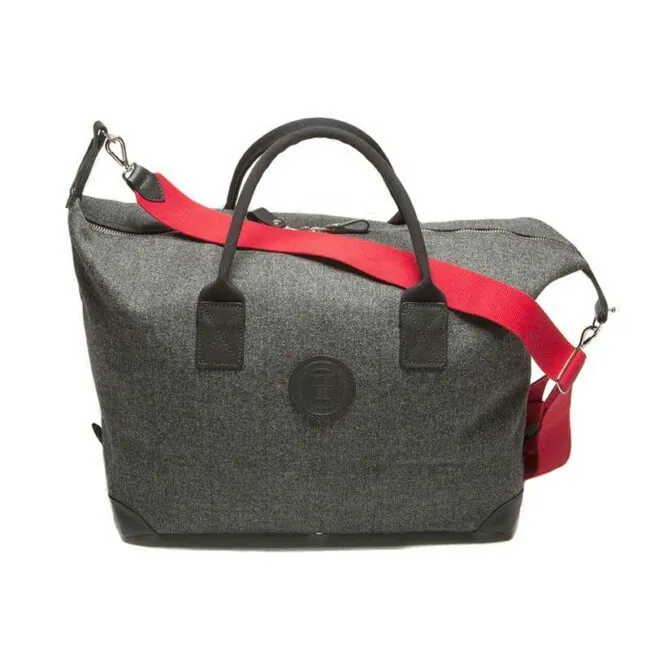
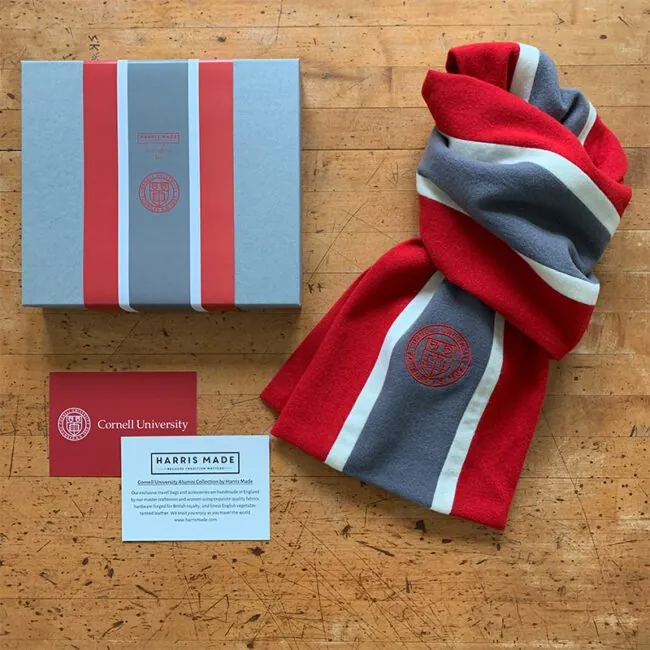
After Cornell University's $6.36 billion campaign, we curated a made-to-order Alumni Collection for the university, alongside a Saxony wool scarf and a medallion badge. Every piece is in the story of Cornell's Alumni Collection.
"Our Harris Made Alumni Collection is gorgeous! We have nothing but praise. I highly recommend working with Harris Made." James Best, General Merchandise Manager, The Cornell Store, Cornell University
Northwestern gave its Alumni Association a silk scarf and tie
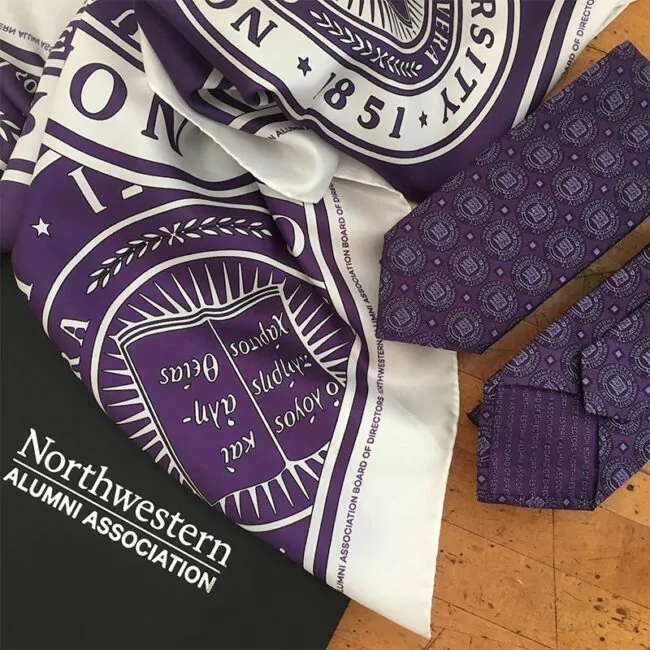
Northwestern's Alumni Association scarf and tie carry the University seal in purple and white. The same commission produced a woven 'N' silk tie, a Saxony wool scarf and an embroidered cashmere scarf. A scarf and tie like these suit the people who carry an institution's name in public, from board members and volunteers to the alumni who receive awards at homecoming.
Kent School made scarves for alumni and parents
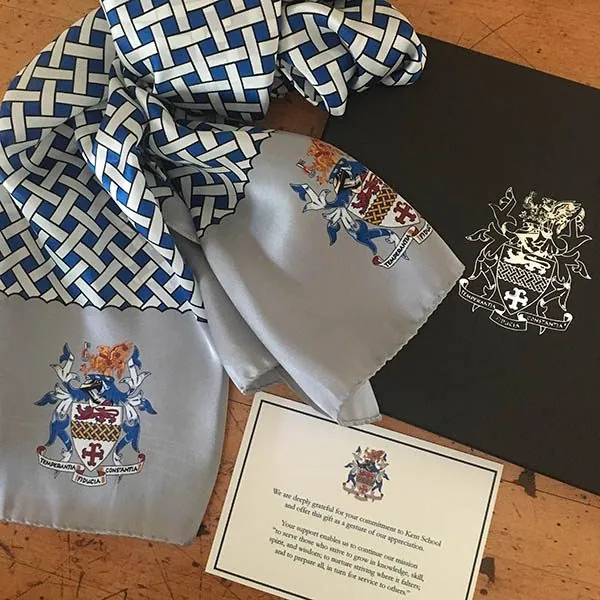
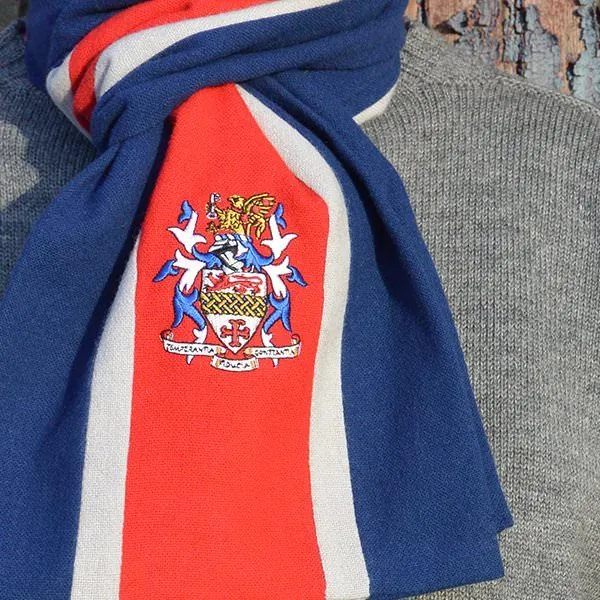
For Kent School, we made a silk scarf with the School's heraldic coat of arms and a Saxony wool scarf in its colors, as gifts for alumni and parents. See Kent School's alumni scarves.
"We were fortunate indeed to find Harris Made when looking for special gifts for our alumni and parents. Harris Made delivered items of exceptional quality with lasting appeal and with a special significance, items that are uniquely KENT." Kathy Nadire, Director of Development, Kent School
Alumni artwork can become the design
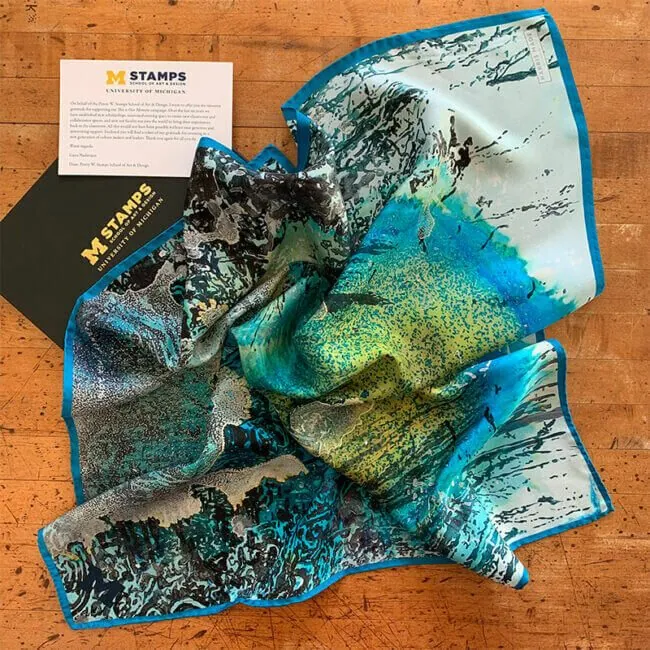
The University of Michigan's Penny W. Stamps School of Art & Design took another route: a silk scarf made from 'Autofagia', a painting by alumnus Jon Verney, MFA '16. When the design comes from a graduate's own work, other alumni get to see what their community makes. Read about a scarf made from an alumnus's painting.
"Harris Made designs are made with such precision, sophistication, and embody a rich story of tradition. They are the perfect recognition gifts for our most loyal alumni and friends." Emily Abrahamson, Donor Engagement, University of Chicago
An alumni piece starts as a sketch

Emma Harris designs every piece, and each one starts as a hand-drawn sketch. She hand-selects the materials, and samples are made for your approval before mills and a foundry in Britain that hold Royal Warrants make the full order. Emma inspects every piece before it is boxed. See how a Harris Made project works.
Saxony scarves were first introduced to students at Oxford and Cambridge as a mark of academic excellence, and ours are woven on the same looms that make the scarlet cloth for the Guards' uniforms at Buckingham Palace. There is more on our craftsmanship page and in our guide on how to design a custom silk scarf.
Most projects take 8 to 16 weeks, and the requested minimum is 125 pieces per design. Prices start from $15 for a lapel pin and $58 for a Saxony wool scarf. If you have a date in mind, ask us about timing.
Alumni gifts turn engagement into belonging
Of the alumni gifts we make, 3 kinds do the most. The first is an alumni collection in the institution's colors. Volunteers and board members tend to get association scarves and ties, and reunion classes get gifts that mark their class year (see our reunion and commencement gift ideas). Our page on university and alumni gifts shows the full range.
Engagement metrics show what is working
Alumni engagement metrics are there to tell you which ideas to keep, and they only do that if you count the same things the same way every year. These 7 cover most programs.
| Metric | Mode | How to count it | What it tells you |
|---|---|---|---|
| Alumni engaged in at least 1 mode | All | Unique alumni with any counted activity in the fiscal year, divided by alumni of record | The headline figure for your board |
| Engagement by mode | Each | Unique alumni active in each of the 4 modes | Where the program is strong and where it is thin |
| Engagement by graduation cohort | All | The first 2 measures, split by decade since graduation | Which classes are drifting away |
| Repeat event attendance | Experiential | Alumni who came to 2 or more events in the year | Whether events build a habit |
| Volunteer retention | Volunteer | This year's volunteers who also served last year | Whether recognition is working |
| Giving participation | Philanthropic | Alumni donors divided by alumni of record | The reach of your giving program |
| Email engagement | Communication | Replies, clicks and survey responses for each segment | Which messages alumni act on |
CASE defines what counts in each mode so that institutions can compare their results. If you want a benchmark, read the participation terms on the CASE survey page and consider taking part.
Some campaigns now report engagement beside dollars. When Cornell closed its To Do the Greatest Good campaign in June 2026, it reported that more than 220,630 alumni, nearly 70% of Cornellians worldwide, had engaged with the university.
Best practices keep the program honest
These alumni relations best practices hold for an office of any size.
- Start with students. Introduce the alumni association before graduation.
- Segment. Choose ideas for each group instead of 1 program for everyone.
- Keep data current. Update addresses and employers every year, because you cannot engage alumni you cannot find.
- Measure by mode. Report all 4 modes and the share of alumni engaged in at least 1.
- Thank volunteers. In person when you can, and with something to wear that marks the role.
- Work with the development team. Share a calendar so alumni do not receive 3 requests in 1 week.
- Ask alumni. Survey them, then tell them what you changed.
Our page on university and alumni gifts shows what we make for graduates, and there are more client stories to read. To begin one of your own, start a project.
Frequently asked questions
What is alumni engagement?
Alumni engagement is the ongoing relationship between graduates and their institution. The Council for Advancement and Support of Education measures it across 4 modes: philanthropic, volunteer, experiential and communication. Most teams count an alumnus as engaged when they are active in at least 1 mode during the year.
What are some best practices for alumni engagement?
Start while students are still on campus, segment your alumni, measure engagement by mode, recognize volunteers and give alumni something to keep. The best practices checklist above covers each one.
How do you increase alumni engagement?
Pick 1 idea for each of the 4 modes and give each one an owner and a month on a 12-month calendar. Run them for a full year, then count the share of alumni engaged in at least 1 way and keep the ideas that moved it.
What are the current trends in alumni engagement?
More offices now measure engagement by mode, often with the CASE framework, instead of counting donors alone. Many are also adding career support for recent graduates and virtual events for alumni who live far from campus.
How do you measure alumni engagement?
Count the unique alumni engaged in each of the 4 modes during a fiscal year, then the share engaged in at least 1. CASE defines each mode, so you can compare results with other institutions.
What is a good message to send to alumni?
A short, personal note that thanks them for something specific and asks for 1 small action, ideally naming their class or program. For example: "Thank you for mentoring our students this spring. Would you meet with 1 more next term?"